Pawn Shop Gold Calculator — How to Know Their Number Before They Do
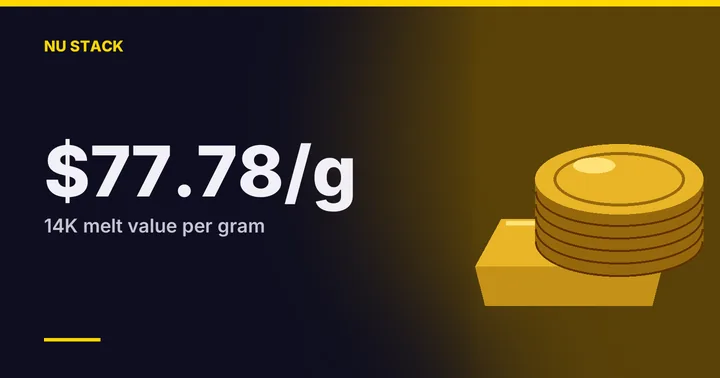
A pawn shop gold calculator works out weight in grams ÷ 31.1035 × purity × spot, so at today's $4,147/oz a gram of 14K is worth about $77.78 in melt and a gram of 10K about $55.56. Pawn shops typically pay 50–65% of melt to walk-in sellers and 70–80% to regulars, so divide any offer by your melt value to see the percentage.
In this guide
Walking into a pawn shop without knowing the melt value of your gold is like negotiating a car price without checking the Blue Book value first. You're relying entirely on the other side of the table to be fair — and while many pawn shops are honest businesses, their job is to buy low. Your job is to know what low actually means.
A pawn shop gold calculator solves this. It takes the weight and karat of your gold, applies today's live spot price, and tells you the melt value — the baseline your piece is worth based purely on gold content. With that number in hand, you can evaluate any offer a pawn shop makes and decide if it's fair.
How a Gold Calculator Works for Pawn Shop Visits
The formula behind every gold calculator is the same one pawn shops use internally:
Melt Value = (Weight in grams ÷ 31.1035) × Purity (decimal) × Spot Price
The purity depends on the karat:
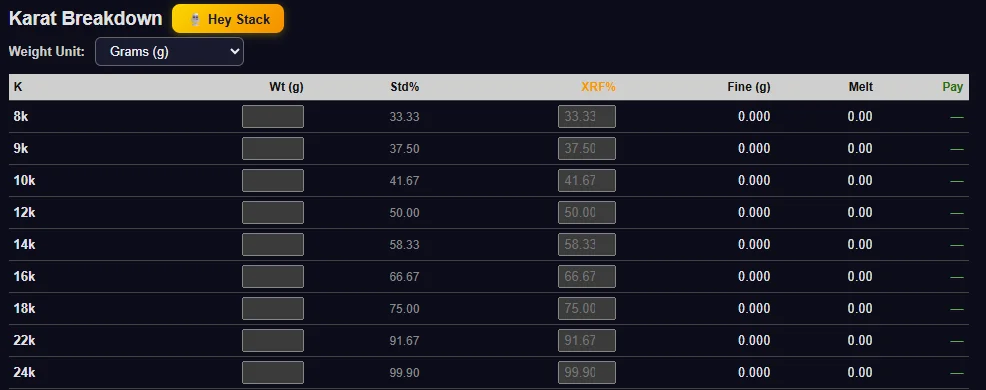
10K = 0.4167 14K = 0.5833 18K = 0.7500 22K = 0.9167 24K = 0.9990
At today's $4,147 gold spot price (October 19, 2026), here's the melt value per gram by karat — these are the numbers to have in your head before walking into any pawn shop:
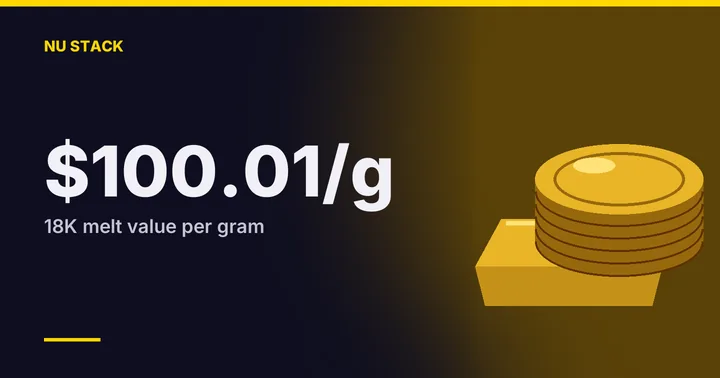
10K: $55.56/gram 14K: $77.78/gram 18K: $100.01/gram 22K: $122.23/gram
Multiply the per-gram value by the weight of your piece and you have the melt value. That's what the gold content is worth at full market price.
What Pawn Shops Actually Pay
Pawn shops don't pay melt value. They pay a percentage of melt — their buy rate. This is how they make money, and it's a legitimate business practice. The question isn't whether they'll pay below melt (they will), but how far below.
Typical pawn shop buy rates for scrap gold:
Walk-in seller, no relationship: 50–65% of melt Semi-regular seller: 60–70% of melt Regular seller with a relationship: 70–80% of melt Exceptional cases (high volume, strong relationship): up to 85%
Let's put real numbers on this. A 14K gold chain weighing 30 grams has a melt value of $2,333 at today's $4,147 spot:
At 50%: $1,167 offer At 65%: $1,517 offer At 75%: $1,750 offer At 80%: $1,867 offer
That's a $700.01 spread between the worst and best-case pawn shop offers on the same piece. The only thing that changes is whether the seller knows the melt value and whether the pawn shop respects them enough to offer a competitive rate.
Why You Need to Calculate Before You Go
The power dynamic in a pawn shop shifts completely when you know the melt value.
Without a calculator: You walk in, hand over the chain, the shop weighs it, tests it, and says "I'll give you $1,143." You have no idea if that's good or bad. Maybe you accept because it sounds like a lot of money. You just sold a $2,333 piece for 49% of its value.
With a calculator: You already know the chain is worth $2,333 in melt value. The shop offers $1,143. You know instantly that's 49% of melt — well below even average pawn shop rates. You counter at $1,657 (71%), and maybe you settle at $1,563 (67%). You just put an extra $420.00 in your pocket.
The calculator doesn't do the negotiating for you. But it gives you the foundation to negotiate from strength instead of ignorance.
How to Use a Gold Calculator Before a Pawn Shop Visit
Here's the step-by-step process for getting the best possible pawn shop deal:
Before you leave the house:
Sort your gold by karat. Group all the 10K together, all the 14K together, and so on. If you're not sure about the karat, check stamps with a loupe or run an acid test.
Weigh each group on a gram scale. Even a $15 kitchen scale that measures in grams will work for this purpose, though a jeweler's scale (0.01g precision) is better.
Open a gold calculator — the free one at nustack.app works well for this — and enter each karat group's weight. Note the melt value for each group and the total.
Decide on your minimum acceptable percentage. For a first visit, 65% of melt is a reasonable target. For an established relationship, aim for 75%+.
At the pawn shop:
Let them weigh and test your gold. Watch the scale — their weight should match yours. If there's a significant discrepancy, ask about it.
When they make an offer, divide it by your pre-calculated melt value to get the percentage. If the total melt value is $2,375 and they offer $1,425, that's 60%.
If the percentage is below your target, say so. "My melt value on this is about $2,375. Can you do better than $1,425?" Most shops will come up if they see you know the numbers.
If they won't budge and the offer is too low, thank them and leave. Try the next shop.
Common Pawn Shop Tactics to Watch For
These aren't necessarily dishonest — they're business strategies. But knowing about them helps you navigate the transaction:
Pennyweight pricing. Some shops quote in pennyweights (dwt) instead of grams. One pennyweight is 1.555 grams. An offer of "$54.44 per pennyweight for 14K" sounds similar to $54.44 per gram, but it actually works out to $35.01 per gram — about 45% of melt at today's spot. Always convert to grams or per-ounce to compare.
Blended karat offers. If you bring a mixed bag of 10K, 14K, and 18K without sorting, some shops offer a single rate based on the average — or worse, based on the lowest karat. Sort before you go.
Urgency pressure. "This price is only good today" or "Gold could drop tomorrow." The scrap gold price at a pawn shop today is based on today's spot, and tomorrow's spot is usually within 1–2% ($41.47–$82.95 an ounce). You have time to think or get another offer.
Below-scale weighing. Rare, but it happens. Watch the scale display and note the weight. If they use a back-room scale you can't see, that's a reason to take your gold elsewhere.
When a Pawn Shop Is the Right Choice
Pawn shops aren't always the worst option. They're the right choice when:
You need cash right now. No shipping, no waiting, no online listing. Walk in, sell, walk out with money.
You have a small quantity. Shipping two rings to a refinery doesn't make financial sense. A pawn shop handles small lots easily.
You have a good relationship with the shop. A pawn shop that consistently pays 75–80% of melt is a solid outlet — only 10–15% less than you'd get from most dealers, with zero hassle.
You're in a location without coin shops or dealers. In smaller towns, the pawn shop might be the only local buyer. Know your melt values and negotiate accordingly.
When to Skip the Pawn Shop
If you have volume (50+ grams of scrap), a refinery will pay 20–40% more than a typical pawn shop offer.
If you have identifiable bullion coins (Eagles, Maples), a coin shop will pay for the premium value above melt that pawn shops typically ignore.
If you have time, private sales through Facebook groups, Reddit, or local contacts can yield 85–95% of melt.
If you have numismatic or antique pieces, a specialist dealer or auction house will recognize and pay for value that a pawn shop will miss entirely.
The Bottom Line
A pawn shop gold calculator is the simplest tool that delivers the biggest impact on your pawn shop experience. Knowing the melt value before you walk in changes the entire dynamic — from guessing whether an offer is fair to knowing exactly what percentage you're being offered.
The math takes a minute. The payoff is hundreds of dollars on a single transaction. Calculate, compare, negotiate, and never accept an offer you can't evaluate.
Frequently asked questions
What percentage of melt do pawn shops pay for gold?
Walk-in sellers with no relationship typically get 50–65% of melt, semi-regular sellers 60–70% and regular sellers 70–80%. High-volume sellers with a strong relationship can get up to 85%.
How much will a pawn shop give me for a 14K gold chain?
A 30-gram 14K chain has about $2,333 in melt value at today's $4,147 spot. At typical pawn shop rates of 50–80% of melt, offers would range from about $1,167 to $1,867.
How do I tell if a pawn shop gold offer is fair?
Divide the offer by your pre-calculated melt value to get the percentage. If the total melt value is $2,375 and they offer $1,425, that's 60%; for a first visit, 65% of melt is a reasonable target.
Why do some pawn shops quote gold per pennyweight?
A pennyweight is 1.555 grams, so a per-pennyweight price looks bigger than the same deal per gram. Divide any per-pennyweight offer by 1.555 before comparing it to per-gram melt value.
When should I skip the pawn shop?
If you have 50+ grams of scrap, a refinery will pay 20–40% more than a typical pawn shop offer. Bullion coins like Eagles and Maples belong at a coin shop, which pays for the premium above melt.
Nu Stack for: Pawn Shop Operators · Scrap Gold & Jewelry Buyers · Deal Hunters & Flippers