14K Gold Value — Per Gram, Scrap & Real Prices in 2026
14K gold is 58.33% pure, so one gram is worth about $77.78 in melt value at today's $4,147/oz gold price. Buyers typically pay 40–98% of melt depending on who is buying, from cash-for-gold storefronts at the low end to refineries at the top.
In this guide
- What Does 14K Gold Mean?
- How to Calculate 14K Gold Value
- 14K Gold Worth Per Gram
- Melt Value vs. What You'll Actually Get
- Why the Stamp Isn't Enough
- 14K vs. Other Karats: Value Comparison
- What Affects 14K Gold Prices Day to Day
- Key Takeaway
- 14K Scrap Gold Value — What Buyers Actually Pay
- 14K Gold Per Gram — Quick-Reference Tables
- How to Verify 14K Before You Pay
- Where to Find 14K Scrap (for Buyers)
- The Bottom Line
If you're holding a 14K gold chain, ring, or bracelet and wondering what it's actually worth, you're asking the right question. The answer depends on three things: today's gold spot price, the weight of the piece, and the purity — which for 14K gold is always 58.33%.
That last number is the one most people get wrong, and it's the reason they either overpay when buying or undersell when cashing out. This is the complete reference on 14K gold value — covering melt value, per-gram pricing, scrap pricing, and what real buyers will actually hand you for a 14K piece in 2026.
What Does 14K Gold Mean?
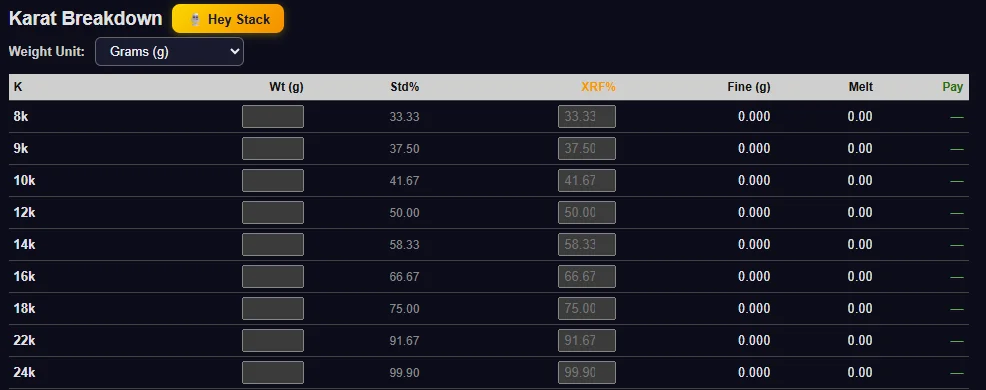
The "K" stands for karat, which measures gold purity — not to be confused with "carat," which measures gemstone weight. Pure gold is 24 karats. 14K gold means 14 out of 24 parts are pure gold, which works out to 58.33% gold content. The remaining 41.67% is made up of alloy metals like copper, silver, and zinc that give the piece its strength and color.
14K is the most common karat in the United States. If you're buying scrap gold domestically, roughly 60–70% of what crosses your path will be 14K. It's the standard for engagement rings, chains, bracelets, and most everyday jewelry sold in the U.S.
How to Calculate 14K Gold Value
Here's the formula, and it works for any karat:
Melt Value = Weight (in troy ounces) × Purity (as a decimal) × Spot Price
Let's walk through it with a real example. Say you have a 14K gold chain that weighs 20 grams and today's gold spot price is $4,147 per troy ounce (as of October 19, 2026).
First, convert grams to troy ounces. There are 31.1035 grams in a troy ounce — not 28.35 like a regular ounce. That 10% difference matters.
20 grams ÷ 31.1035 = 0.6430 troy ounces
Next, multiply by the 14K purity:
0.6430 × 0.5833 = 0.3751 troy ounces of pure gold
Finally, multiply by the spot price:
0.3751 × $4,147 = $1,556 melt value
That's what the gold content alone is worth at today's spot price. It's the baseline — the floor — for what that chain should sell for based purely on metal value.
14K Gold Worth Per Gram
A faster way to think about it: take the current spot price, divide by 31.1035 to get the price per gram of pure gold, then multiply by 0.5833 for the 14K purity.
At today's $4,147 spot price, one gram of pure gold is worth about $133.34. One gram of 14K gold is worth about $77.78.
That per-gram number changes every time the spot price moves, which is why you should never memorize it — always calculate it fresh. Tools like the Nu Stack Calculator pull the live spot price and do this math instantly. Enter the weight, select 14K, and the melt value updates in real time.
Melt Value vs. What You'll Actually Get
The melt value is the theoretical worth of the gold content. What you'll actually receive depends on who you're selling to:
Refineries typically pay 95–98% of melt value. They're melting it down anyway, so they pay close to full value. The tradeoff is you need enough volume to justify shipping costs, and turnaround takes one to three weeks.
Pawn shops usually pay 50–75% of melt value for walk-in sellers. If you have a relationship with the shop and sell regularly, you can negotiate higher. But for a one-time seller walking in off the street, expect a steep discount.
Local coin shops and gold buyers typically pay 70–85% of melt value, depending on the shop and your relationship with the owner.
Private sales (Facebook Marketplace, Craigslist) can get you closer to melt value, but they come with safety considerations and the time cost of finding a buyer.
The gap between melt value and what you're offered is how the buyer makes money. Understanding that gap is how you decide whether a particular offer is fair.
Why the Stamp Isn't Enough
A piece stamped "14K" or "585" (which is the European marking for 14K — 58.5% purity) is a starting point, not a guarantee. Stamps can be wrong, worn, or deliberately misleading. Experienced buyers always verify with testing — acid tests, electronic testers, or XRF analysis — before paying based on a karat claim.
If you're evaluating a piece and the stamp says 14K but something feels off — the color is too light, it's heavier than expected, or the magnet test raises questions — test it before you calculate value based on 14K purity. A piece stamped 14K that actually tests at 10K changes the math by about 30%.
14K vs. Other Karats: Value Comparison
To put 14K gold worth in context, here's how it stacks up against other common karats at today's $4,147 spot price, per gram:
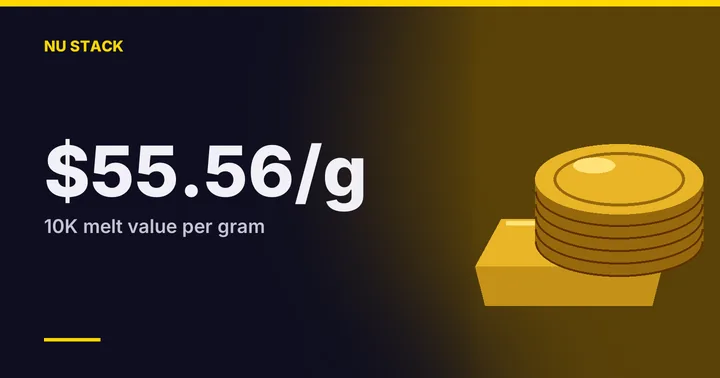
10K (41.67% pure): ~$55.56 per gram
14K (58.33% pure): ~$77.78 per gram
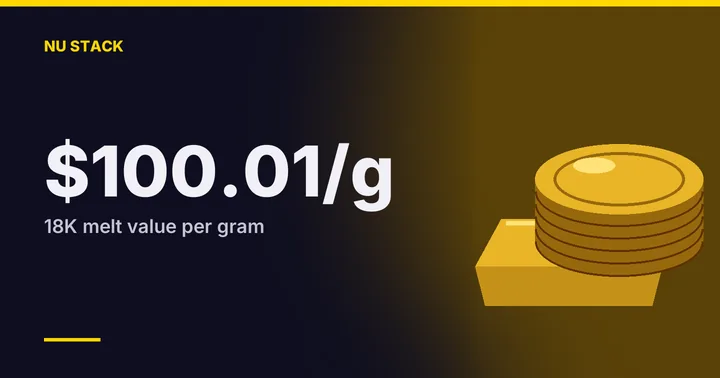
18K (75.00% pure): ~$100.01 per gram
24K (99.90% pure): ~$133.21 per gram
The jump from 10K to 14K is about $22.23 per gram. From 14K to 18K, it's about the same again. Every step up in karat adds roughly the same dollar amount per gram because the purity increases are roughly evenly spaced.
What Affects 14K Gold Prices Day to Day
The gold spot price moves throughout the trading day based on global supply and demand, central bank policy, inflation data, currency strength, and geopolitical events. Your 14K gold chain doesn't change weight or purity, but its melt value shifts with every tick in the spot price.
This is why timing matters if you're selling — not in a "try to time the market" sense, but in a "don't sell the day after a big drop" sense. Check the spot price before you walk into a pawn shop or coin dealer, and know your melt value before anyone makes you an offer.
Key Takeaway
14K gold is worth exactly 58.33% of the current spot price per troy ounce, multiplied by its weight. That's the melt value — the pure metal value — and it's the number every buyer and seller should know before making a deal.
If you want to check the current value of any 14K gold piece, nustack.app has a free calculator that pulls live spot prices and handles the math for any weight and karat. It's worth a look before your next buy or sell.
14K Scrap Gold Value — What Buyers Actually Pay
When 14K is sold as scrap (rather than as wearable jewelry), the price drops to a percentage of melt value. The industry-standard buy rates by buyer type:
- Refineries: 95–98% of melt. On a 25-gram chain worth $1,944 in melt at today's spot, expect $1,847–$1,906.
- Coin shop / gold dealer: 78–88% of melt → $1,517–$1,711 on the same chain.
- Pawn shop: 55–75% of melt → $1,069–$1,458.
- Cash-for-gold storefront: 40–60% of melt → $777.78–$1,167.
- Private sale: 85–95% of melt — if you find the right buyer.
The spread between worst and best offer on the same piece can be more than $972.23. The whole game is knowing the melt value before you hear an offer.
What 14K Scrap Pieces Are Actually Worth (at today's $4,147 spot)
| Piece | Weight | Melt Value |
|---|---|---|
| 14K class ring | 15 g | $1,167 |
| 14K wedding band | 6 g | $466.67 |
| 14K chain | 25 g | $1,944 |
| 14K bracelet | 20 g | $1,556 |
| 14K hoop earrings | 3 g | $233.34 |
| Mixed 14K lot | 40 g | $3,111 |
These are melt-value floors. Add design / antique / brand premium where it applies; subtract for stones and non-gold settings.
14K Gold Per Gram — Quick-Reference Tables
Here's what 14K gold is worth in melt value at today's spot and at spot levels above and below it:
| Spot Price | 14K $/g | 14K $/dwt (1.555g) | 14K $/troy oz |
|---|---|---|---|
| 20% below today: $3,318 | $62.22 | $96.76 | $1,935 |
| 10% below today: $3,733 | $70.00 | $108.85 | $2,177 |
| 5% below today: $3,940 | $73.89 | $114.90 | $2,298 |
| Today: $4,147 | $77.78 | $120.95 | $2,419 |
| 5% above today: $4,355 | $81.67 | $126.99 | $2,540 |
| 10% above today: $4,562 | $85.56 | $133.04 | $2,661 |
| 20% above today: $4,977 | $93.33 | $145.13 | $2,903 |
Every $200 change in spot moves 14K per-gram value by about $3.75. On a 50-gram lot, that's nearly $190.
Watch Out for Pennyweights
A pawn shop offering "$70.00 per pennyweight for 14K" sounds comparable to the $77.78 per-gram melt value, but a pennyweight is 1.555 grams. $70.00/dwt = $45.02 per gram — under 60% of melt. Always convert offers to per-gram before comparing.
How to Verify 14K Before You Pay
- Stamp: Look for
14K,14KT,585, or583. Check clasps, ring shanks, earring posts. Use a 10× loupe. - Magnet test: Gold isn't magnetic. A neodymium magnet eliminates obvious fakes in two seconds.
- Acid test: Scratch on a testing stone, apply 14K acid. If the streak survives, the piece is at least 14K. A kit costs $15–25.
- Stones: Subtract stone weight before calculating. For pinhead accents, ignore. For meaningful stones, weigh after removal — or estimate and adjust your offer accordingly.
A stamp is a starting point, not a guarantee. Re-stamps, fakes, and worn marks all exist. If you're paying 14K prices, verify you're getting 14K gold.
Where to Find 14K Scrap (for Buyers)
14K is everywhere because it's the dominant U.S. karat:
- Estate sales — jewelry boxes are usually 60–70% 14K. Arrive early, know your per-gram numbers cold.
- Pawn shops — see the pawn shop guide for negotiation playbooks.
- Facebook Marketplace — sellers often don't know what they have. Always meet in public, bring a scale and acid kit.
- Garage sales / thrift stores — hit or miss, but the wins are exceptional.
- Word of mouth — once people know you buy gold, deals come to you with no competition.
The Bottom Line
14K gold is worth exactly 58.33% of the current spot price per troy ounce, multiplied by its weight. That's the melt value floor — every buyer and seller should know it before making a deal.
For depth on related topics: 10K gold value, today's scrap gold value by karat, the complete scrap gold buying guide, and the gold karat calculator.
Frequently asked questions
How much is 1 gram of 14K gold worth?
At today's $4,147/oz spot price, one gram of 14K gold holds about $77.78 of gold. The math is spot ÷ 31.1035 × 0.5833, so the number moves every time spot moves.
How much is a 14K gold chain worth?
Weigh it in grams and multiply by the per-gram melt value. A 20-gram 14K chain is worth about $1,556 in melt at today's spot and a 25-gram chain about $1,944, before subtracting any stones or non-gold parts.
What do pawn shops pay for 14K gold?
Pawn shops usually pay 50–75% of melt value to walk-in sellers. On a 25-gram 14K chain worth $1,944 in melt, that's roughly $972.23 to $1,458, while a refinery would pay 95–98%.
What does 585 mean on gold jewelry?
585 is the European fineness stamp for 14K gold, meaning 58.5% gold. A stamp is a starting point, not a guarantee, so test the piece before paying 14K prices.
How do I compare a per-pennyweight offer to per-gram value?
Divide the per-pennyweight offer by 1.555, because one pennyweight is 1.555 grams. An offer of $70.00 per pennyweight for 14K works out to only $45.02 per gram, well under the $77.78 per-gram melt value.
Nu Stack for: Scrap Gold & Jewelry Buyers · Beginners · Estate Sale & Inheritance Buyers