Gold Karat Calculator — Convert Karats to Purity & Value
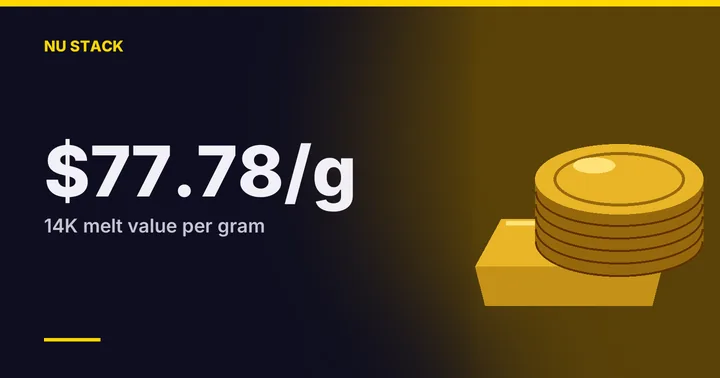
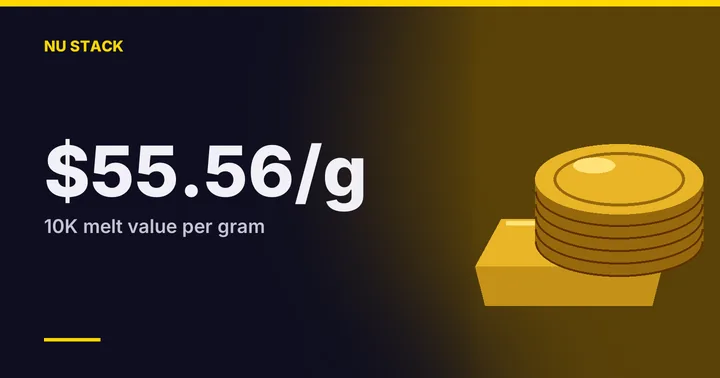
A karat calculator divides the karat by 24 to get purity (14K = 58.33%), then multiplies the weight in troy ounces by that purity and the spot price. At today's $4,147/oz gold, that makes one gram worth about $55.56 in 10K, $77.78 in 14K, $100.01 in 18K and $133.21 in 24K.
In this guide
A karat is a unit of gold purity — a way to express how much of a piece is actually gold versus alloy metals. It's the most important number in any gold transaction, because two pieces that weigh exactly the same can have wildly different values depending on the karat.
Understanding how the karat system works and how a karat calculator turns that number into a dollar value is fundamental to buying, selling, or evaluating gold of any kind.
How the Karat System Works
The karat system divides gold purity into 24 parts. Pure gold is 24 karats — meaning all 24 out of 24 parts are gold. Every karat below 24 means some of those parts are alloy metals instead of gold.
The formula is: Purity Percentage = Karat ÷ 24 × 100
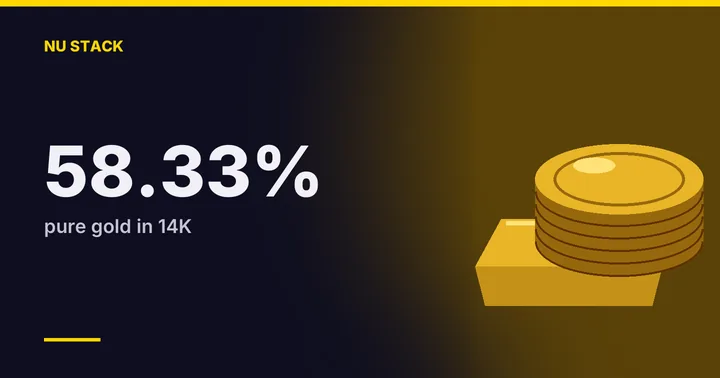
So 14 karat gold is 14 ÷ 24 = 58.33% pure gold. The remaining 41.67% is made up of alloy metals — copper, silver, zinc, nickel, and sometimes palladium — that give the piece its color, hardness, and durability.
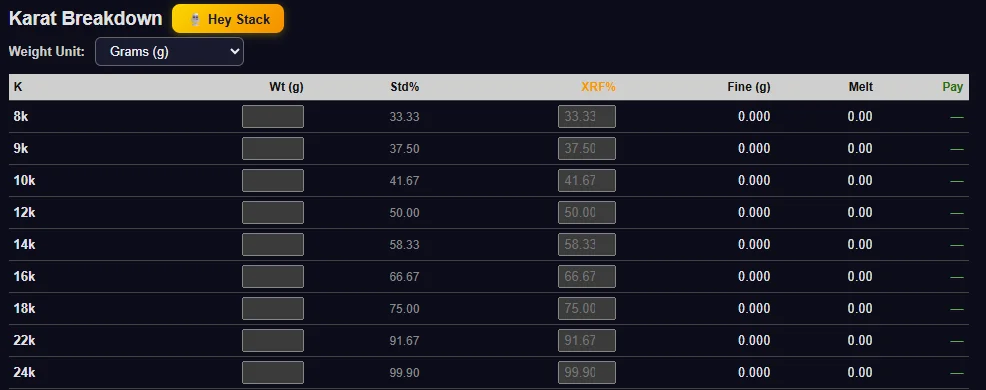
Here's every common karat and its gold content:
8K — 33.33% gold. Used in European jewelry, particularly in Germany and parts of Italy. The minimum legal karat for gold jewelry in several European countries.
9K — 37.50% gold. Common in the United Kingdom and Australia. Below the U.S. minimum standard but perfectly legal and common in those markets.
10K — 41.67% gold. The minimum legal karat to be labeled "gold" in the United States. Common in class rings, everyday chains, earrings, and budget-friendly jewelry.
12K — 50.00% gold. Less common as solid jewelry. You'll see "12K" more often in gold-filled markings (e.g., "1/20 12K GF").
14K — 58.33% gold. The most popular karat in the U.S. Standard for engagement rings, wedding bands, quality everyday jewelry. The sweet spot between gold content and durability.
16K — 66.67% gold. Uncommon in the U.S. but seen in some European and Asian jewelry markets.
18K — 75.00% gold. The European standard for fine jewelry. Higher gold content gives it a richer yellow color but makes it softer and more prone to scratching than 14K.
22K — 91.67% gold. Used in Indian jewelry and some bullion coins like American Gold Eagles. Very soft — too soft for most jewelry applications but prized for its color and near-pure composition.
24K — 99.90% gold. Essentially pure gold. Used in bullion bars, Maple Leaf coins, Buffalo coins, and some Asian jewelry. Too soft for everyday wear.
Karat vs. Carat: Not the Same Thing
"Karat" (with a K) measures gold purity. "Carat" (with a C) measures gemstone weight — one carat equals 0.2 grams. A "14K gold ring with a 1-carat diamond" uses both terms with completely different meanings. The gold is 58.33% pure; the diamond weighs 0.2 grams.
In some countries (particularly the UK), "carat" is used for both gold purity and gemstone weight. Context usually makes the meaning clear, but in the U.S., the standard is K for gold and C for stones.
How a Karat Calculator Works
A karat calculator takes three inputs and produces the melt value — the dollar amount the gold content is worth:
Input 1: Karat — Determines the purity percentage. Input 2: Weight — The total weight of the piece in grams, pennyweights, or troy ounces. Input 3: Spot Price — The current market price per troy ounce of pure gold (updated live by the calculator).
The formula: Melt Value = (Weight in grams ÷ 31.1035) × (Karat ÷ 24) × Spot Price
That's all a karat calculator does — it applies the karat purity to the weight and multiplies by the current price. The power is in doing it instantly with live prices instead of fumbling with manual math during a transaction.
Karat Calculator in Action: Examples
All four examples use today's gold spot price of $4,147 (October 19, 2026).
Example 1: A 10K gold chain weighing 22 grams: 22 ÷ 31.1035 × 0.4167 × $4,147 = $1,222 melt value
Example 2: An 18K gold ring weighing 7 grams: 7 ÷ 31.1035 × 0.7500 × $4,147 = $700.05 melt value
Example 3: A 14K gold bracelet weighing 30 grams: 30 ÷ 31.1035 × 0.5833 × $4,147 = $2,333 melt value
Example 4: A 22K gold pendant weighing 5 grams: 5 ÷ 31.1035 × 0.9167 × $4,147 = $611.17 melt value
These calculations take about 15 seconds on a phone calculator. With a dedicated karat calculator like the one at nustack.app, they take about three seconds — select karat, enter weight, read the number.
Why the Karat Matters So Much
To see how dramatically karat affects value, compare rings that all weigh exactly 10 grams at today's $4,147 spot:
10K ring: $555.64 melt value 14K ring: $777.78 melt value 18K ring: $1,000 melt value 22K ring: $1,222 melt value 24K ring: $1,332 melt value
Same weight. The 24K ring is worth more than double the 10K ring. This is why accurate karat identification is critical — buying a 10K piece at 14K prices means you overpaid by 40%. Selling an 18K piece at 14K pricing means you gave away 29% of its value.
How to Identify the Karat of Gold
Karat stamps — The most common identification method. Look for markings like "10K," "14K," "18K," "585" (14K European), "750" (18K European), or "916" (22K). Stamps are found on clasps, inside ring bands, on earring posts, and near end caps on chains. Use a loupe or magnifying glass.
Acid testing — Chemical tests that confirm karat. Apply acid of a specific karat to a scratch from the piece on a testing stone. If the scratch dissolves, the piece is below that karat. If it holds, the piece is at or above. Work from low to high: start with 10K acid, then 14K, then 18K.
XRF analysis — An X-ray fluorescence analyzer gives an exact purity reading. Instead of just "14K," it tells you "58.2% gold." This is the gold standard for professional buyers and worth the investment if you're handling volume.
Electronic testers — Handheld devices that give a karat reading. Less precise than XRF but faster than acid testing and non-destructive.
The stamp isn't always right. Stamps wear off, get added to non-gold items, or simply lie. A piece stamped 18K that tests at 14K is worth 23% less than the stamp suggests. Always verify before paying based on a stamp.
Multi-Karat Calculations
Real-world scrap buying often involves evaluating pieces across multiple karats at once. A seller might bring in a 10K class ring, two 14K chains, and an 18K pendant.
Without a multi-karat calculator, you'd run the formula four separate times and add them up. With one, you enter each karat and weight on separate lines and the calculator totals the melt value across all of them.
This matters most when you're working fast — at a pawn shop counter, at an estate sale, or meeting a seller who has a mixed bag. Being able to calculate a total melt value for a mixed lot in under a minute keeps you in control of the transaction.
The Bottom Line
A karat is a 1/24th unit of gold purity. A karat calculator turns that purity into a dollar value based on weight and today's spot price. Together, they give you the melt value — the single most important number in any gold transaction.
Know the karat system. Verify the karat on every piece. Run the calculation before money changes hands. Whether you're buying scrap at a garage sale or selling jewelry at a coin shop, the karat calculator tells you what the gold is actually worth. Everything else is negotiation.
Frequently asked questions
How do you convert gold karat to purity?
Divide the karat by 24. 10K is 41.67% gold, 14K is 58.33%, 18K is 75%, 22K is 91.67%, and 24K is 99.9% in practice.
What is the difference between karat and carat?
Karat (with a K) measures gold purity; carat (with a C) measures gemstone weight, and one carat is 0.2 grams. In the UK, 'carat' is used for both.
How much is a 10-gram gold ring worth?
At today's $4,147 spot, a 10-gram ring holds about $555.64 of gold in 10K, $777.78 in 14K and $1,000 in 18K. Same weight, very different values, which is why the karat matters.
What do 585 and 750 mean on gold?
They are European fineness stamps: 585 is 14K and 750 is 18K, and 916 is 22K. Verify with a test before you pay, because stamps wear off or can be wrong.
Nu Stack for: Scrap Gold & Jewelry Buyers · Beginners · Estate Sale & Inheritance Buyers