Selling Gold & Silver Coins — The Complete Guide
Prices in this guide are as of October 19, 2026 (gold $4,147/oz, silver $57.35/oz) and update automatically.
In this guide
Selling gold coins isn't complicated, but selling them well requires knowing what you have and matching each coin to the right buyer. A common-date American Gold Eagle and a rare pre-1933 double eagle are both gold coins, but they sell through entirely different channels at very different prices.
This guide covers how to price your gold coins, where to sell them, and how to avoid the mistakes that cost sellers money.
Topic Index — Everything Under This Pillar
Deep dives across the selling-coins workflow:
- How to sell silver coins for the best price
- Where to sell silver — buyer channels compared
- Scrap silver prices and silver melt value
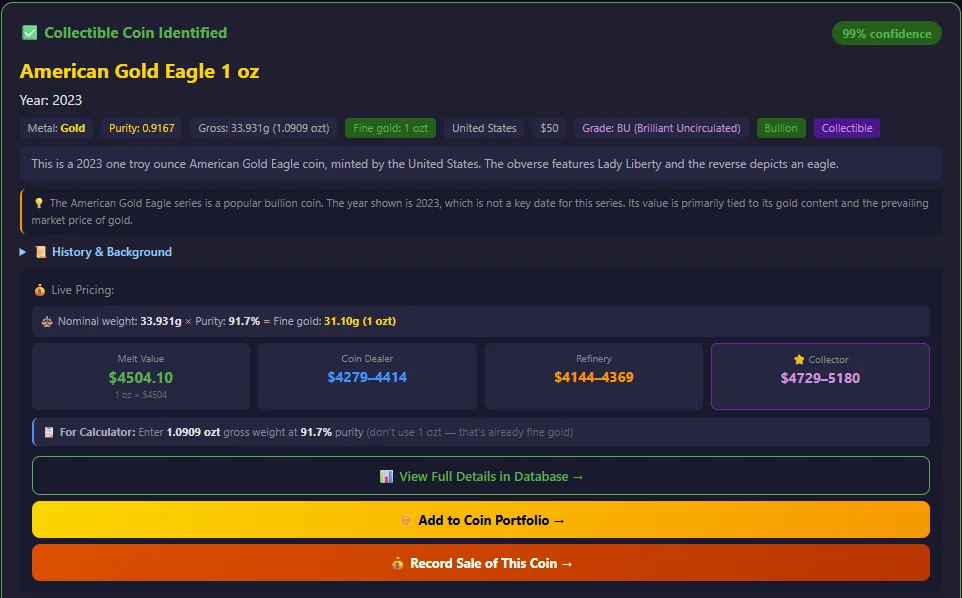
- AI coin identification — know what you have before listing
- Building a $10K silver stack and the gold-silver ratio — timing context
Identify What You're Selling
Gold coins fall into three broad categories, and each one is valued differently:
Modern bullion coins — American Gold Eagles (AGE), Canadian Maple Leafs, South African Krugerrands, Austrian Philharmonics. These are valued primarily for their gold content plus a standard premium. They're the easiest to sell because every coin shop, dealer, and online buyer in the world recognizes them instantly.
Pre-1933 U.S. gold coins — $2.50 Quarter Eagles, $5 Half Eagles, $10 Eagles, $20 Double Eagles. These were circulating currency before the U.S. went off the gold standard. Common dates trade at a modest premium over melt. Key dates and high-grade examples can be worth multiples of their gold content.
Numismatic and proof coins — Coins valued primarily for rarity, condition, and collector demand. The gold content is secondary. These include proof Gold Eagles, limited-edition mint products, and rare world gold coins. Selling these requires finding collectors willing to pay for the premium, not just the metal.
Before pricing anything, identify each coin by type, date, mint mark, and condition. A few minutes of research can prevent you from selling a rare coin at bullion prices.
Calculate the Gold Content
Even if your coin has numismatic value above melt, you need to know the gold content as your starting point. Here's the gold content for the most common gold coins:
American Gold Eagle (1 oz): 33.93 grams total, .9167 fine (22K). Contains exactly 1 troy ounce of pure gold. At today's $4,147 spot: $4,147 melt value.
American Gold Eagle (1/2 oz): 0.5 troy ounces pure gold. $2,074 melt.
American Gold Eagle (1/4 oz): 0.25 troy ounces pure gold. $1,037 melt.
American Gold Eagle (1/10 oz): 0.1 troy ounces pure gold. $414.74 melt.
Canadian Maple Leaf (1 oz): 31.1 grams, .9999 fine (24K). Contains 1 troy ounce of pure gold. $4,147 melt.
South African Krugerrand (1 oz): 33.93 grams, .9167 fine (22K). Contains 1 troy ounce of pure gold. $4,147 melt.
$20 Saint-Gaudens Double Eagle: 33.44 grams, .900 fine. Contains 0.9675 troy ounces of pure gold. $4,013 melt at today's spot.
$10 Liberty Eagle: 16.72 grams, .900 fine. Contains 0.4838 troy ounces of pure gold. $2,007 melt.
Melt value is the absolute floor — no gold coin should sell for less than its gold content. Everything above that is premium.
Understand Premiums
The premium is the amount above melt value that a coin commands. Premiums vary significantly by coin type and market conditions:
Modern bullion coins carry relatively consistent premiums. A 1-ounce American Gold Eagle typically sells for spot plus 2–4% ($4,230–$4,313 at today's $4,147 spot). Premiums on 1-ounce gold coins are usually the lowest as a percentage of the gold value.
Fractional bullion coins (1/2, 1/4, 1/10 oz) carry higher premiums as a percentage. A 1/10-ounce Gold Eagle with $414.74 in gold content might sell for $472.80–$497.69. That premium is 14–20% of gold value. Fractional gold is more expensive per ounce to own, and this premium difference matters when selling.
Pre-1933 U.S. gold coins in common dates and average condition carry modest premiums — perhaps 5–15% over melt. Key dates, rare mint marks, and high-grade examples can carry premiums of 50% to several hundred percent over melt. Knowing which dates are key dates is critical.
Proof and limited-edition coins have premiums driven by mintage numbers and collector demand. These premiums can be volatile — high when collector interest is strong, compressed when the market is soft.
Where to Sell Gold Coins
Local Coin Shops
The go-to for most sellers. Walk in, show your coins, get an offer, walk out with cash.
Coin shops typically pay 95–98% of the going rate for common bullion coins (spot plus most of the standard premium). For numismatic coins, the offer depends on the shop's clientele and expertise — a shop that specializes in rare coins will offer more for numismatic material than a shop that mainly deals in bullion.
Get offers from at least two shops. Prices vary, and a five-minute drive to a second shop can mean 2–3% more on a significant sale.
Online Dealers
Major online dealers (APMEX, JM Bullion, SD Bullion, and others) have "sell to us" pages with current buy prices. These are competitive for bullion coins, especially in larger quantities where the per-ounce savings on a better rate outweigh shipping costs.
The process: lock in a price over the phone or online, ship your coins insured, receive payment after the dealer verifies. Turnaround is typically one to two weeks.
Private Sales
Reddit's r/Pmsforsale, collector forums, Facebook groups, and local precious metals communities are all venues for selling directly to other collectors and stackers. Private sales typically yield the highest prices because you're cutting out the dealer's margin — the buyer pays close to retail, and you receive close to retail.
The tradeoff is time and effort. You'll need to take photos, list the coins, handle communications, pack and ship, and manage the transaction. For high-value coins, the extra work is worth the extra money.
Auction Houses
For genuinely rare or high-grade numismatic coins, a reputable auction house (Heritage Auctions, Stack's Bowers) can maximize your return by exposing the coins to competing collectors. Auction houses charge fees — typically 10–20% between buyer's premium and seller's commission — but a competitive auction can drive prices well above what any single dealer would offer.
Only worth it for coins with significant numismatic premiums. Don't auction a common-date Gold Eagle — sell it to a dealer and save the fees.
Mistakes That Cost You Money
Selling rare coins as bullion. A 1911-D $2.50 Indian Gold Quarter Eagle is worth thousands to collectors but only $501.42 in melt. Always check dates and mint marks against a price guide before selling any pre-1933 U.S. gold coin as generic gold.
Cleaning coins before selling. Never clean gold coins — especially numismatic ones. Cleaning removes the natural patina, creates micro-scratches visible under magnification, and can drop a coin's grade by several points. Lower grade means lower value. Collectors want original surfaces.
Not knowing the current premium. If Gold Eagles are selling online for $4,218 and your coin shop offers you $4,085, you're leaving $132.72 on the table. Check what your specific coins are currently selling for before accepting an offer.
Accepting the first offer. Whether you're selling one coin or twenty, get at least two offers. The difference between dealers is real — one might pay $4,131 for an Eagle while another pays $4,181.
Selling fractional gold expecting full-ounce premiums. Fractional coins carry higher premiums when buying but those premiums compress when selling. A 1/10-ounce Eagle you bought for $472.80 won't sell for that amount to a dealer. Expect closer to $443.77–$452.07 on resale. This isn't a ripoff — it's how the fractional market works.
Ignoring tax implications. Gold coins held longer than one year are typically taxed as collectibles at up to 28% on gains. If you bought a Gold Eagle at $2,800 and sell it at $4,100, you may owe tax on the $1,300 gain. Consult a tax professional — the specifics depend on your situation, holding period, and filing status.
How to Get the Best Price
Sort your coins by type. Sell bullion through one channel and numismatic coins through another — the best buyer for each is usually different.
Know the melt value of every coin before selling. It's your absolute floor and the basis for evaluating any offer.
Research current sell prices online. Check what your specific coins are listed for on dealer websites and auction results. That tells you the ceiling.
Your fair sale price is somewhere between melt value (floor) and current retail (ceiling). Where it lands depends on the buyer and how you sell.
The Bottom Line
Selling gold coins well comes down to knowing what you have, knowing what it's worth, and finding the right buyer. Bullion coins sell quickly to any coin dealer or online buyer. Numismatic coins need collectors. Rare coins might belong at auction.
For a quick melt value check on any gold coin, the calculator at nustack.app handles the weight and purity math instantly. Start with the melt value, research the premium, and then go find the best offer.
Nu Stack for: Coin Collectors · Coin Shop Dealers · Retirees & Long-Term Holders